Showing posts with label Reading. Show all posts

Sunday, April 15, 2018

Week 14 Reading Notes Part A: Zelinda and the Monster

-It makes no sense to me that the father would go home and tell his daughter that the dragon wanted to eat him or her- is he basically telling her that he will not be the one to be eaten? I understand that he said the family will be destroyed if he is eaten, and most likely in those days it would have been the end of the world for a family if the man was gone, but how could a father go home and ask his daughter to basically go and sacrifice herself?
-I love all the names in this story, the names of the daughters are so beautiful
-Okay so I HATE the ending of this story. So the girl does not need to love the dragon, just needs to consent to be his wife. Wrong. She needs to love him, that's what Disney told me. And, how does the dragon turning into a youth save the girl's dad from dying? i don't get that at all. He basically forced her to marry him, because what daughter is not going to try to save her father at any cost? (Maybe one who's father basically gave her to a dragon so he could live)
-This story is just way too based on physical characteristics, and I much prefer the Disney version and how she learns to love him despite his beastly appearance. Maybe I could retell the story but the father tries to sacrifice himself, and the dragon falls in love with the father (plot twist?). The girls would not be able to get along well at all and the dragon would have to let him go to go take care of his family, but then they all come back to live in the castle together and live happily ever after.

Story source: Italian Popular Tales by Thomas Frederick Crane (1885).

File:DnD Dragon.png
(Link)

Saturday, April 14, 2018

Week 13 Extra Credit Reading: Through The Looking Glass Part 2

I read the second half of Through the Looking Glass for my extra credit reading this week because I enjoyed the first half so much last week. I found the second half to be more exciting than the first but also much more confusing and a little hard to follow. The first half, while whimsical and non-sensical, did seem to have a plot while the second half seemed to go on meandering and it was easy to get lost. While a resounding theme throughout the story was poetry, the story made it seem like Alice was going to slay the Jabberwocky or that it would seem somewhat important, and then we read it and never heard from it again. The whole use of pawns and knights was quite clever, and I liked how the knight kept falling off the horse- I read on wikipedia that this was supposed to imitate the L-shaped movements that knights make on a chess board. I would like to read the whole book, I think that would make the ending make a little more sense to me. I found it very interesting how Tweedle Dee and Tweedle Dum talked about Alice being in the Red King's dream, and if she woke him up then she would cease to exist. But they are in her dream. Very existential. The wordplay that existed between the two queens and Alice was so creative, but I found it strange that they were friends rather than being enemies like you would think they would be in a chess game. So once Alice grabbed the Red Queen and started shaking her, she put the Red King in checkmate and "won" the game and was allowed to wake up, according to Wikipedia. It was just amazing how all these details that seem to be so whimsical and random actually came together to tie into the major themes of the story

Story source: Through the Looking-Glass, and What Alice Found There by Lewis Carroll (1871).

Friday, April 13, 2018

Week 13 Reading Notes B: Fairie Queen: Britomart unit

I did not like the ending of this story, how we did not find out what happened to Amoret, and how Britomart became this wooing wife who could not stand to see her husband go and was literally making up excuses for him not to leave. Why couldn't they go on the quest together? She had obviously proven her skill with a sword and could take care of herself, she did even better in the tournament than her husband. I just hate that after all this time they could not give her a better ending. And she did not even get to keep her best friend, but rather she got stolen in the desert or something like that.
I am interested in writing a story with a different ending, maybe Britomart sees Artegall and while he is beautiful and everything that the mirror showed her, there was nothing beneath the surface. She had fallen in love with her idea of him, the dream she had made up in her head of him since she was a child. But now that she had been on this adventure and found out that she can take care of herself, she realized that he was not what she needed to fulfill herself. So instead of just running off and marrying him, she goes and finds Amoret, and deals with the loss of this driving quest that has been leading her for her entire life. And then maybe she finds that knight that she met at the castle from the first half of the unit, because they were actually friends and genuinely enjoyed each other's company. But wait he was committed to his wife (maybe she dies, sad) but I just want it to be deeper than "she was so pretty and he fell in love"

Story source: Stories from the Faerie Queene by Mary Macleod, with drawings by A. G. Walker (1916).

Britomart viewing Artegal: an illustration from Book III, Part VII of an 1895-1897 edition
(Link)

Week 13 Reading Notes A: Fairie Queen: Britomart unit

It is kind of sad that there is such an awesome princess who can throw knights from their horses, and yet still her whole mission in life is not to free the oppressed or accomplish amazing tasks like the male knights, but is of course to go find a man she saw in a mirror. I am all for love but why can't she someone along with all these other things? Would she be fine with sitting in her castle if she had not seen this man? Seems like a waste of a heroine. And further more, is this man searching for her as desperately as she is searching for him? Or is he off winning fame and glory doing knightly things? The double standards, as always, are irksome
-I'm definitely at least seeing some more powerful women in this story, but again with the six knights, its because she "has beauty that has no rival". So would knights swear to serve her if she was not pretty?
-Ok so it says further on that even as a child she liked to use weapons and hunt and did not like ladylike things, which is cool and different but again with the lovestruck puppy stuff, it is just so one-dimensional
-Scudamour sounds like a toddler, and would likely be more successful in his knightly efforts if he would stop flinging his armor on the ground and laying face down and throwing tantrums
-I like that Britomart seems to not be interested in material wealth
-So Merlin told her that the brave strong knight would become king and have lots of sons and kings as offspring, but he never said it would be with her. She seems to be putting a lot of faith in a shadow of an image she saw in a mirror

Story source: Stories from the Faerie Queene by Mary Macleod, with drawings by A. G. Walker (1916).

Heavily armed woman in armour, rescuing a semi-nude woman from a wild-eyed man and trampling on a blood-stained book

Week 12 Extra Credit Reading Notes: Looking Glass Unit

Lewis Carroll has such an interesting way of writing that is quite nonsensical but still allows you to follow the story and not focus on the details and how much they are not making sense
-Alice is a lot younger in this story than when I think of her in Alice in Wonderland. She tells Humpty Dumpty that she is only seven and six months, and she seems quite aware for her age
-The people in the looking glass house are not very nice to her, but she does not seem particularly upset by that, rather I think she understands that this is a part of the world that she is in
-There is a lot of poetry in this reading and normally I do not like poetry but I actually enjoyed it quite a lot in this reading, it was quite light and read very easily
-I like the shift from Alice being in a house that somewhat resembles her normal world, and she is somewhat in control there and illustrates it by picking up the chess pieces and moving them around, but as time goes on it shifts and she becomes the one who does not know what is going on and the world becomes crazier and more nonsensical
-I do not understand how Alice went from not being able to be seen by the chess pieces to being seen by Tweedle Dee and Tweedle Dum, but perhaps that was in the chapters that were skipped in the reading
-Lewis Carroll obviously put a lot of work into writing the Jaborwocky poem because the words, although nonsense, do actually intuitively make some sense when Humpty Dumpty explains them. It is obvious that he did not pick random words and make them mean something, he picked words that matched his meaning and I think that is even more creative and makes the poem make sense before it is even explained

Story source: Through the Looking-Glass, and What Alice Found There by Lewis Carroll (1871).

Monday, April 9, 2018

Week 12 Reading Notes Part B: King Arthur

-Seems like knights just walk around looking for grand ways to die. Where are their wives, reminding them not to act like toddlers and maybe just act reasonably for a day or two? I can feel the testosterone seeping out of these stories
-The castle of Maidens sounds like every guy's fantasy
-Lancelot is a lot more interesting of a character to me than Arthur. It seems that he tries to be good, but he has a past that is holding him back from the grand  and holy quests that are just outside his reach. That is much more human and much more realistic. Can you imagine being a knight and being on a quest for the holy grail and then it is within your grasp and you have to watch another knight take advantage of it, and then steal your sword and horse? That would be torture. That could be an excellent metaphor for our past holding us back from love, or a family, or the career we wanted, which is a sad but often too real truth.
-The nun is pretty harsh to Lancelot, basically saying that as far as being a sinner he is in a league of his own. Like he is the first guy to cheat on his wife. He obviously seems to repent his actions but the world just seems to keep punishing him even when he tries to make amends and do right.
-So after all the shame that they placed on Lancelot, he is kind of the last knight and he gets to have this grand burial and get to go up to heaven and be crowned the goodliest knight and truest lover- this all does not make a whole lot of sense to me. I found these stories to be very confusing

Story source: King Arthur: Tales of the Round Table by Andrew Lang and illustrated by H. J. Ford (1902).

File:Emil Teschendorff - Queen Guinevere bidding farewell to Sir Lancelot.jpg
Queen Guinevere bidding farewell to Sir Lancelot by Emil Teschendorff (1833-1894)

Week 12 Reading Notes Part A: King Arthur

-It is interesting that Merlin tried to counsel Arthur out of marrying Guinevere, saying that he could find someone who is just as pretty but is a much better person. It is like he knows that something bad is going to happen, but it is typical that Arthur only cares about her looks. I do agree with the statement that once a heart is set on someone it is futile to try and change it, however
-Women are getting a pretty bad rap in these tales. The woman who Merlin loved basically treated him like a plaything and then buried him alive after she had gained all his knowledge. His sister stole his scabbard and then tried to burn him alive with a mantle.
-Arthur is pretty one-dimensional. I wish he would have more of a struggle, I feel like the only struggle he has is being a little arrogant, which if you pull the sword out of the stone I think you're allowed to be a little arrogant.
-I have heard a lot about Guinevere in popular media and such but they almost begrudgingly give her a section of the story, and they allude to her possibly not being the best but then we just hear of her as "the queen" from then on
-It would be really interesting to hear about the feud between Arthur and his sister from Morgan's point of view- why did Arthur have to kill the knight that she loved? Was he a bad person? Or was Arthur being overprotective of his sister? Were they close before then? It would take a lot to cause a sibling to hate another so much that she tries to kill him, so the knight must have meant a lot to Morgan. There is a lot of potential there to flesh out

Story source: King Arthur: Tales of the Round Table by Andrew Lang and illustrated by H. J. Ford (1902).
File:Frank William Warwick Topham Voyage of King Arthur and Morgan Le Fay to the Isle of Avalon 1888.jpg
Voyage of King Arthur and Morgan Le Fay to the Isle of Avalon by Frank William Warwick Topham (1838-1924) - Source

Monday, April 2, 2018

Extra Credit Reading: Andersen Fairy Tales

-What about a princess is not as it should be? Do they not wear their crown in the right spot? Is their corset not cutting off enough of their circulation? I thought a princess was defined as the offspring of a king and queen, that does not seem to be that hard to verify
-Also the prince seems to have a pretty serious princess fetish Im just saying
-Why is a princess standing alone in the rain? Isn't there supposed to be like 40,000 servants surrounding her to help her breathe and everything?
-I like to look back in history at some really amazing princesses who championed for their subjects, and this story makes all princesses seem like the epitome of spoiled brats
-The emperor's new suit is HILARIOUS, I am just picturing some old guy staring at an empty loom oohing over how beautiful it is. That is fabulous. And then the emperor has to pretend he sees the clothes, and then put them on and walk in a parade. I don't know if I could rewrite this story, because it is just so hilarious to begin with. And the swindlers who were faking just eagerly weaving away at fabric that is not there. This might be my favorite story that I have read out of all of them.
-Haha, the world looked like a map- did they still think the earth was flat then?
-I think most great conquerers of the world think that they have conquered even God, but I have yet to read a story where they dare try. It seems like a lot of work for God to send an angel down and let the angel bleed and then for the man to continue to live, but maybe that is because God is forgiving. i did like that he was taken down by a little gnat

(Image from Michael Clarke at Flickr)

Story Source:  Fairy Tales and Stories by Hans Christian Andersen, translated by H. P. Paull (1872).

Week 11 Reading B: Sioux Unit

-It is interesting to have Iktomi's appearance described in such great detail, I have not really seen that in my other readings of the native american tales
-It would be terrible to not have a friend in the world, and I think particularly in the Native American culture where it seems they are very social to not even have an animal that is your friend is a testament to how bad of a person Iktomi is
-I wonder what it would sound like to have ducks singing
-When they all go into the hut to hear Iktomi singing, it really reminded me of a cult. I could turn this into a story where Iktomi runs into money problems and really needs help, so he creates a cult and invites people in, and they are heavily pushed to donate. But maybe one person investigates the cult and finds out the money is going to Iktomi. But Iktomi made part of being in the cult a requirement to not ask any questions, so by asking questions that person "opened his eyes". Something like that. And then of course when he runs away and goes home he would get robbed by someone else, and maybe the robbers beat him up because they found out he has a bunch of money in his house from the cult. It could be set in modern day and maybe the news advertised that a cult leader made away with like $20,000 worth of offerings given by cult members.
-In the rewrite Iktomi could have really elaborate ceremonial garb that he puts on when he begins to recruit people for the cult and they all come to see this grand show that he puts on and they get sucked into the way he sings and dances and the shows he does and then he asks them to give their life savings to the cult.

This story is part of the Sioux unit. Story source: Old Indian Legends by Zitkala-Sa (1901).

Artist Gertrude Spaller's rendition of Iktomi in the story Iktomi and the Ducks (Source)

Week 11 Reading A: Sioux Unit

-I like to think of the medicine woman as kind of a trickster, someone who is giggling as the boy keeps stumbling. Maybe in the rewrite he will hear the trees shaking their leaves in laughter and the wind giggling as it passes over his behind sticking up in the air from where it had fallen
-Brave would be strong and mischievous, and I see his six little groupies following him around the village waiting to ooh and awe at his every move. Maybe he will be the chief's son, bred for greatness and leadership
-I am very confused, because it says when Brave rushed to the village he was as badly scared as the rest and he ran to his mother's tent. Was the thin quavering voice that they said was like an old woman's not Brave's, but actually the medicine woman's?
-In the rewrite I would like Brave to be laying down in the grave when he hears a rushing through the wind, and a whisper of chanting like an old medicine woman would do. When he looks over he sees a pair of wise old eyes. Brave screams and bolts straight up, and that is when his friends see him and run away. Following that, Brave runs into the village and scares all of the women, etc. Basically I would like the medicine woman's ghost to play a much more active part in the story, and be pretty mischievous in teaching Brave a lesson about playing jokes on his friends. Maybe I could open up about Brave having some disdain for the medicine man currently. Maybe he thinks that it is a different time and that those kinds of things do not work any more. Maybe his father is telling him a ghost story and Brave scoffs at it because he does not believe in ghosts

This story is part of the Sioux unit. Story source: Myths and Legends of the Sioux by Marie McLaughlin (1916).

Betsy Thunder, medicine woman of the Ho-Chunk tribe in Wisconsin, 1913 (Source)

Extra Credit Reading Notes: Tales of a Parrot

-This is the most eloquent parrot I have ever heard. I am giving him the voice of the parrot from Aladdin, and would like to rewrite a story in which he is quite funny and snarky on top of being intelligent
- I feel bad for Khojisteh, I know she loves her husband but six months without seeing him is a very long time, particularly in a  society such as the one she lived in where women were not allowed to go where they wanted and do what they please
-The parrot is much smarter than the other bird, I did not expect Khojisteh to be so violent and to slam the bird against the ground and kill it. This reminds me of the arabian nights tales where the girl is telling tales to preserve her life, this must be a common theme in this region
-It would be terrible to have all of your feather plucked off, I think in my retelling I would have the parrot make the woman pluck every hair from her head so she knows what it feels like
-I like that in this story the male, who is supposed to be the head of the household and know everything that is going on, in reality has no idea what is going on and is kind of just a pawn in the scheme that is between the parrot and the woman. I also like that this story allows for mistakes without it having to ruin the woman's whole life.
- I think this story could be turned really funny, the parrot and the woman could live in the burial ground for forty days and become good, sarcastic friends.
-It is interesting how intelligent and respected parrots are in these stories, I had no idea they had such a reputation


Source: This story is part of the Tales of a Parrot unit. Story source: The Tooti Nameh or Tales of a Parrot, by Ziya'al-Din Nakhshabi (1801).

Thursday, March 29, 2018

Week 10 Reading B: Native American Marriage Tales

- I wonder how the wife who did not bear the man any children felt- did he scorn her? I imagine since that is the defining feature of these wives that this is an important quality in this society
-So this guy just abandons his wives and child for this mysterious woman. Where did her child come from? Was he worried about the father of that child?
-It is interesting that these people are willing to be killed and eaten by their own kind, and then revived. But again, I have to wonder what happened to the man's original family. Were they just abandoned by their father?
-I wonder if the people remember being killed once they have had their bones tossed in the water and they are revived. It would not be fun to be killed and it would be hard to not resent someone for killing you, even if you volunteered for the job and did so for the good of the group
-So the hunter's people just accept him back because his new wife pulls a bunch of food from underneath her arm? I would think they would have some questions, but maybe the deer people are seen as an elevated people and to join them is like joining a religious group and you cannot say no
-It is cool how much respect the story gives to the deer. It treats the species as their own people and the way hunting is described is how I think nature was supposed to be used. We see animals as mindless beings, but Native Americans viewed them almost as equals, and made up endless tales about them and gave them spirits and respect. Its beautiful and it also makes for great stories. I still hate that the guy left his family, he should have at least let them know he was not dead

This story is part of the Native American Marriage Tales unit. Story source: Tales of the North American Indians by Stith Thompson (1929).

Tuesday, March 27, 2018

Week 10 Reading A: Native American Marriage Tales

-Okay first things first, he took advantage of her situation? So he raped her. So this cow was tied up (I don’t know what fast in the mire is but need to look that up), and this guy raped her and she gave birth to a boy. Maybe as a cow she didn’t care, but I think even animals had feelings. What kind of creep goes around raping cows?
-Secondly, why is the boy so keen to find his cow-raping dad? And I do not see his dad coming and searching for him. The dad does not seem to have any interest in having a son. How would the son know what to look for? There needs to be more detail in the retelling
-So when the dad comes to the cow she charges at him, which I can get on board with. But then it simply says “Then she went home with her husband and child”. Where’s the wedding? How does she feel? She is a remarkably good woman and deserves to be treated as such
-So this guy strikes her with a burning stick because she did not feel like cooking a feast for his guests? He does not sound like a very good husband
-I thoroughly enjoy that he had to rub himself in what I can only assume is buffalo feces

- I do not think the man should have been resurrected after being trampled by the buffalo. He did not deserve the wife and son he had, and could not recognize his own son among the calves. His wife and son should have moved on and been better off without him. I would like to rewrite the story where they move on to remain buffalos and have a happy life. Maybe the son becomes chief of the buffalo heard.

This story is part of the Native American Marriage Tales unit. Story source: Tales of the North American Indians by Stith Thompson (1929).

Thursday, March 15, 2018

Week 9 Reading: Congo, Part B

-There is a sense of justice to a lot of the Congo stories, and a sense of Karma- if you harm your family or do not share what you have, then you will be punished either by fate or by some fetish or spirit. I think in a place like Africa where poverty is so widespread they have to believe in a sense of justice, and they have to believe in pooling their resources otherwise many of them would not survive. I imagine in day-to-day life family and important village members just police the village and make sure that everyone is pulling their weight, but it is more fun to think of it happening by spirits
-I wonder why Basa who seemed so afraid seemed so willing to follow the little servant. Why did he not jsut run?
-Sunga was quite dramatic in the way she punished him for not sharing his resources. She could have just made the fish disappear or just taken his voice, but instead she led him into her little lake town and gave him this big feast.
-We do not get to see how Basa reacts to having his voice gone. Was he too scared to protest? Was he furious but could not make a sound? And how did his family see it? Did they see the punishment as too harsh or fair for letting all of the fish rot?
-I like that there was a female lead in this story who took out justice on a man, that was refreshing
-It would be easy to convert this into a modern tale- it could be a family member who became a famous singer but did not share her wealth with her family, so a spirit comes and takes her voice so she can no longer sing

Story source: Notes on the Folklore of the Fjort by Richard Edward Dennett (1898).

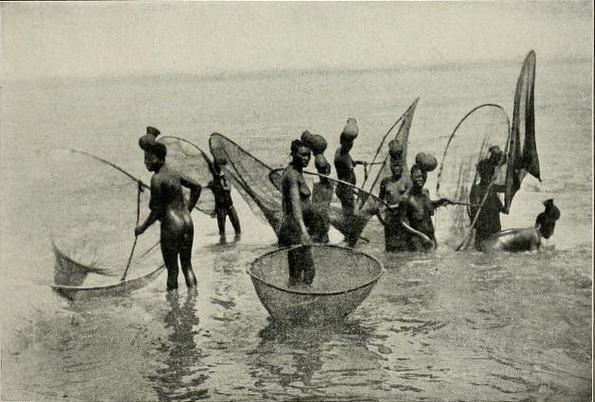
File:Women fishing in congo free state, 1906.png

Tuesday, March 13, 2018

Week 9 Reading: Congo, Part A

The jealous wife is such a sad story, but I guess the wife deserved what she got for trying to kill the other wive's child. I imagine they lived together, and I cannot believe that a woman would murder a child that she lived with. However, Africa is a much harsher environment than here, and I cannot begin to imagine how different things are there. Another thing is that I think it would be very hard to be the elder and share a husband, and the wife must have had a lot of jealousy against the younger wife. This probably fueled her drive to murder the son. I still do not think a mother would mistake her own child for another.
At the end when they gave her the poisonous bark, I imagine it was probably as a punishment. But to me it almost seemed as if it was a mercy killing. She was never going to forgive herself for killing her own child, her life was over at that point. And her husband was never going to trust her again or see her the same after she killed their child.
Jealousy can drive people to do such terrible things. I think people get it so worked up in their heads and they create these monsters out of people when they are really innocent.
It would be very easy to retell this story in a modern setting. Maybe the two wives could be sisters and the one sister is jealous of the other sister's child, but instead of killing them she aims to ruin their chances to get into a good school by framing them for a crime. But she ends up framing the wrong child, and her child gets sent to jail. The lesson of jealousy would still be there just in a modern time.

Story source: Notes on the Folklore of the Fjort by Richard Edward Dennett (1898).

Image from page 358 of "Women of all nations, a record of their characteristics, habits, manners, customs and influence;" (1908)

Thursday, March 1, 2018

Reading Notes B: The Monkey King

The incident with the monkey king in the peach garden could be transferred into a modern story in which the girl gets cocky when her business becomes successful. Maybe she is in fashion and she starts to become successful and begins to have people wanting to wear her clothes, but she does not want to mentor other girls and give them the opportunities that someone gave her. She does not invest in her brand but just spends the money on material things, and does not respect the people in her field who have been there far longer than she has and try to give her advice. Possibly she is invited to do a small fashion show and she kind of thinks it is beneath her so she does not prepare, and it ends up being so-so and the reviews are not great but she does not care because she is enjoying her material wealth and her house and her business. The peach banquet could be turned into a grand gala, where all the big names in fashion are invited but the girl is not invited because of how she has not cared and the fact that she has not yet earned a reputation in fashion. So she sneaks in and embarrasses herself in front of all these big names by getting too drunk. All in all, the monkey king is careless and arrogant and does not have any regard for the gods, and I want to make the girl not have any regard for anyone else. Except her children of course, who she will always care for. There will of course be redemption at the end but it will be a classic story of getting everything she ever wanted and realizing she is not handling it in the generous and humble way that she thought she would.

Story source: "The Ape Sun Wu Kung" in The Chinese Fairy Book, ed. by R. Wilhelm and translated by Frederick H. Martens (1921).

Tuesday, February 27, 2018

Reading Notes A: The Monkey King

-It is strange to me that the Lord of the Heavens would be frightened by anything
- The ape seems like kind of a bully, but he is going on a quest to fulfill a desire that most people have- to beat death.
-It is interesting that there are so many ways to fulfillment- through the sciences or through magic or repose. I agree with that, that one can be fulfilled and find purpose and their true calling in a variety of ways. It is crazy that the master would know all of them, but maybe that is why he has all of the disciples.
-I would like to make a modern version of the monkey king, maybe a single mom moves to a new city with her children and is attempting to establish herself in a career and finds a mentor who knows everything. She would have to have some huge goal- to start her own business perhaps? And all of the apes that it talks about in this story could be her children. And the weapon that the monkey seeks out could be the perfect piece of real estate for her new business.
-Maybe dragging back to the underworld could be her getting a call that she has to go home, and maybe she cuts ties with someone she knew back then - the children's father who does not contribute anything? There are so many overarching themes in this story that I can play with.
-The monkey king is boastful and impulsive, and my modern mom can be that way as well. Maybe she has a smart mouth that gets her in trouble and causes her mentor to have to fire her from her job, but that is the push she needs to start her own business. Maybe I will set it in tokyo.

Story source: "The Ape Sun Wu Kung" in The Chinese Fairy Book, ed. by R. Wilhelm and translated by Frederick H. Martens (1921).

Tuesday, February 20, 2018

Week 6 Reading: Arabian Nights, Part B

-I wish that Aladdin had been more deserving of the life he ended up having. The story said he was so idle that it killed his father. That does not seem like the kind of boy who deserves the riches of the world and the sultan's daughter, etc.
-The magician said that if Aladdin touched anything in the cave he would die, yet it says he grabbed fruit?
-I do not know how the sultan's daughter forgave a man who stole her and her husband away on her wedding night and then slept in her bed with her. How terrifying would that be? I do not think I could ever get past that, no matter how much Aladdin was in love with her
-If the lamp was so dang important, maybe Aladdin should not have left it lying around where anyone could get it
-I miss the flying carpet. Maybe I can incorporate that into a retelling
-I wonder why the magician needed the genie of the lamp when he already had the genie of the ring? maybe the genie of the lamp is more powerful? It seems like they can both do the same things
-It would be really fun to elaborate on the wedding from the point of view of the sultan's daughter. What a whirlwind of thoughts she must have been having. She had to have been suspicious of where this really rich man came from, and then there is all that conflicting feelings about him basically kidnapping her and scaring the crap out of her. And how did she feel about the grand-vizir's son? Did she love him? Was she happy to be rid of him and that was why she accepted Aladdin so readily? As per usual she does not get much say in the matter


Story source: The Arabian Nights' Entertainments by Andrew Lang and illustrated by H. J. Ford (1898).

Week 6 Reading: Arabian Nights, Part A

-I love how confident Scheherazade is in herself and her capabilities. And how brave too! She was willing to sacrifice herself for women all throughout her country, even though she was one of the few women who might have been safe. She had so much promise with her education and her beauty and she was not only willing to risk her life but she was willing to be married to the Sultan to do it. I cannot imagine the Sultan was young or good looking and he must have been kind of a monster to do the things he did. I understand its a bummer that the woman you loved turned out to be bad, and I know the story said he basically lost his mind, but that does not make it okay that it was his sole mission in life to rid the world of women. So this young, intelligent, beautiful, wealthy girl gave up her marriage prospects and was willing to risk her life in order to save other women from this fate. That is amazing! How traumatizing would it be to have to try to save your own life every single day. Thank goodness her sister was there to support her, that is the only way she could have gotten through it. I like to think the Sultan was not a monster, his grief just made him lose his mind.
-How impossible must it have been to be the grand-vizir, to have to collect women to die every day. I think I would rather die than do that job. I would run away with my family and live somewhere else, or I would just let them kill me. I don't think I could bring women to slaughter like cattle. But I love that a woman was able to save herself through her wit in this story, she did not have to use her beauty or anything else

Sheherazade and Sultan Schariar by Ferdinand Keller


Story source: The Arabian Nights' Entertainments by Andrew Lang and illustrated by H. J. Ford (1898).

Wednesday, February 14, 2018

Reading Notes: Egypt, Part A

-The Egyptians seem to place a lot of importance on magical deeds and gather a lot of entertainment from hearing about magical acts. The wax crocodile seems to me to be a sad tale of lovers who met a sour end, but it seems like it was told as a form of entertainment among the royals

-I wonder if the crocodile liked being bossed around. Maybe the crocodile could “disappear” and then come back later to seek revenge on the man who made him kill that youth. Maybe the crocodile is a sweet, gentle animal who just wants to live in a lake and do no harm

-The poor woman! Being burned at the stake with no chance to explain herself. I am sure the chief scribe is a busy man and is able to have the attention of any female he pleases. But God forbid a woman strays and breaks the bond of marriage! I cannot imagine a chief scribe is the most attentive husband, what with him being so busy doing magic and other acts.

-Also, what is considered a youth in this case? Is that like a teenager? Because if so, ew that lady is probably too old for him and I am picturing some gross rich lady- pool boy nonsense going on.

-The story mentions a “certain magic box” and there is definitely a lot of story-telling potential there. Maybe the box grants great power to whoever owns it, but at what cost?


-The story said seven days passed and the crocodile held onto the youth within the lake, how did the boy not drown? How did the crocodile not eat him? I guess that is not the most implausible part of this story but still does not make a whole lot of sense to me.


Egyptian, Late Period - Ptolemaic Period, 664 BC-30 BC

Story source: Egyptian Myth and Legend by Donald Mackenzie (1907).