Monday, April 30, 2018

Growth Mindset: 25 Simple Ways To Develop A Growth Mindset

I read the article 25 Simple Ways To Develop A Growth Mindset

I wanted to read this article because while I find the growth mindset to be really fascinating, sometimes it can get overwhelming to think about implementing it formally into the educational system. We are years away from that, but I don't think that means that we can't encourage the children we interact with with a growth mindset in small ways.

Some of the suggestions were things I already knew, such as replacing failing with learning and learning to look forward to and tackling challenges.

Some of the suggestions really surprised me though. For instance, one of the suggestions is to stop looking for approval. While I don't know how we could implement this in children, I think this would have far-reaching benefits not only on intelligence but also on self-esteem and the person as a whole.

Sunday, April 15, 2018

Week 14 Reading Notes Part A: Zelinda and the Monster

-It makes no sense to me that the father would go home and tell his daughter that the dragon wanted to eat him or her- is he basically telling her that he will not be the one to be eaten? I understand that he said the family will be destroyed if he is eaten, and most likely in those days it would have been the end of the world for a family if the man was gone, but how could a father go home and ask his daughter to basically go and sacrifice herself?
-I love all the names in this story, the names of the daughters are so beautiful
-Okay so I HATE the ending of this story. So the girl does not need to love the dragon, just needs to consent to be his wife. Wrong. She needs to love him, that's what Disney told me. And, how does the dragon turning into a youth save the girl's dad from dying? i don't get that at all. He basically forced her to marry him, because what daughter is not going to try to save her father at any cost? (Maybe one who's father basically gave her to a dragon so he could live)
-This story is just way too based on physical characteristics, and I much prefer the Disney version and how she learns to love him despite his beastly appearance. Maybe I could retell the story but the father tries to sacrifice himself, and the dragon falls in love with the father (plot twist?). The girls would not be able to get along well at all and the dragon would have to let him go to go take care of his family, but then they all come back to live in the castle together and live happily ever after.

Story source: Italian Popular Tales by Thomas Frederick Crane (1885).

File:DnD Dragon.png
(Link)

Saturday, April 14, 2018

Famous Last Words: Through the Looking Glass

This week I read about Britomart in The Faerie Queene, and I really enjoyed that story. As per usual, the women did not get a lot of the rights and respect that I would like, but I did enjoy that it was about a female knight who was breaking the mold and going out to find her love. That style of writing was really enjoyable to me, and flowed really well. I did not realize that The Faerie Queene was so long, and I do not know if I would want to read all of the books published for the entire epic, but I did enjoy the short segment that I read. I finished up the second half of Through the Looking Glass too, and was extremely impressed by the intricate detail of Lewis Carroll's writing. There were so many ways that he fit a chess match into his story without being obvious or obtuse. I would really like to go back and read the entire story. I also did not realize that Alice was only seven years old in both those stories, because she has been portrayed as so much older in recent movies that I have seen. There is kind of a darkness in his writing, or at least a queerness that is not childlike at all, although I think a child could enjoy these stories very much. But it is interesting to read them as an adult because you get the sense of something much different when reading the exact same words. I also think the text has a special prose that a movie simply cannot capture, particularly since Through the Looking Glass focuses so much on poetry. All in all I really enjoyed my readings this week and I am kind of glad I have forced myself into doing some extra credit so I can do these readings.

Life-size statue of Alice Through the Looking-Glassin the grounds of Guildford Castle

Wikipedia Trails: From The Faerie Queene to The Lancasterian System

This week I read about Britomart of The Faerie Queene epic, so I decided to start there:

The Faerie Queene
This is an epic poem written in the 16th century by Edmund Spenser, and is one of the longest epics in the English language. This poem follows knights and inspects various virtues, and was praised by Queen Elizabeth I.

Chastity 
Britomart was the emulation of the virtue chastity, which involves sexual behavior that is considered virtuous by the culture involved. This commonly involves sexual abstinence before marriage and modest clothing, especially in history.

Shakers
One religious movement of the 17th century that took chastity to the extreme were the Shakers, who required celibacy upon admission to the belief system. Children were added to the group by adoption or other measures. This group believed in equal gender roles and women took a leadership role in religious affairs, which is pretty cool.

Lancasterian System
The Shakers practiced a Lancasterian educational system, which involved the older students helping the teacher and providing knowledge to the younger students. A variety of merit-based rewards were used for motivation. This seems fairly in-line with current psychological research on motivation and positive vs. negative rewards.


Count Confalonieri and Silvio Pellico attend a demonstration of the Bell-Lancaster method in the Piedmont, Italy (1860s).

Learning Challenge: Procrastinator Types

I used this infographic  to determine what type of procrastinator I am - and determined I am an avoider, which is described as someone who procrastinates as a way to avoid being judged for their success or failure. I did not find that to be particularly accurate for me, but I also disagreed with the descriptions for the other two options as well. I do not find a thrill for working against a deadline (although I do work better against a deadline - but that's not a thrill, right?), and I am not indecisive. I feel like I procrastinate simply because I find more fun things to do with my time until it is absolutely the last chance I have to do something. However, I also don't think I am a very bad procrastinator, my college classes have kind of beat that out of me. I would have liked a quiz or infographic with more detailed questions and possibly more options for final categories.

(Link)

Growth Mindset: Eight Ways of Looking at Intelligence

This week I read an interesting article called Eight Ways of Looking at Intelligence (Link). This article focused not only on looking at intelligence not only as something that is fluid, not fixed (i.e. growth mindset) but looking at objects and situations that can affect our intelligence in specific ways. One thing that was confirmed by this article was that situations affect our intelligence. A high-stress or low-motivation situation is not going to nurture intelligence in the same way that a low-stress, nurturing environment will. One thing that I thought was really interesting was the article touched on how when we use tools, our brain can actually prune neurons to visualize the tool as an extension of our body. But tools can be good or bad, and can take our attention away from what we need to focus on. This article struck me as a practical application of the growth mindset.

(Link)

Typing Test Tech Tip

I did the typing test tech tip this week, because I consider myself to be a fairly quick typer. I grew up with computers and I am a scribe in the ER, which involves a fair amount of typing. I used KeyHero.com and was found to have a 90% accuracy rate and type at 80 WPM. My score went down to about 75 WPM when my accuracy rate went to 100%. I liked this test for the length, it was very short, but I did not like that it counted it as inaccurate even if you took the time to go back and fix the typo. Past typing tests I have taken do not count errors if you take the time to go back (thus sacrificing WPMs) to correct your mistakes. I think that is considered fairly fast, and has certainly been fast enough to serve my purposes in class and at work. Quick typing is crucial and will only become more of a required general job skill as time goes on and technology becomes more and more integrated into our daily lives.

Week 13 Extra Credit Reading: Through The Looking Glass Part 2

I read the second half of Through the Looking Glass for my extra credit reading this week because I enjoyed the first half so much last week. I found the second half to be more exciting than the first but also much more confusing and a little hard to follow. The first half, while whimsical and non-sensical, did seem to have a plot while the second half seemed to go on meandering and it was easy to get lost. While a resounding theme throughout the story was poetry, the story made it seem like Alice was going to slay the Jabberwocky or that it would seem somewhat important, and then we read it and never heard from it again. The whole use of pawns and knights was quite clever, and I liked how the knight kept falling off the horse- I read on wikipedia that this was supposed to imitate the L-shaped movements that knights make on a chess board. I would like to read the whole book, I think that would make the ending make a little more sense to me. I found it very interesting how Tweedle Dee and Tweedle Dum talked about Alice being in the Red King's dream, and if she woke him up then she would cease to exist. But they are in her dream. Very existential. The wordplay that existed between the two queens and Alice was so creative, but I found it strange that they were friends rather than being enemies like you would think they would be in a chess game. So once Alice grabbed the Red Queen and started shaking her, she put the Red King in checkmate and "won" the game and was allowed to wake up, according to Wikipedia. It was just amazing how all these details that seem to be so whimsical and random actually came together to tie into the major themes of the story

Story source: Through the Looking-Glass, and What Alice Found There by Lewis Carroll (1871).

Friday, April 13, 2018

Week 13 Story: Britomart's Decision

This was the moment that Britomart had been waiting for. She gazed up at Artegall's face and felt... nothing? Well that was strange. Britomart looked again, to be sure. Yep, everything checked out. Strong jawline, wavy golden locks, hunky blue eyes. It was all there, just like the mirror showed it would be. So why wasn't her heart all aflutter like it was supposed to be? Maybe she wasn't doing this right. Britomart tried squinting her eyes but nothing changed. She just didn't see anything behind those eyes. He seemed like a nice man, but no different from all the other men who were wooed by her good looks. She had known from a young age that she was more than just a pretty face, and it was a rare man who saw that in her. She had been sure Artegall, the man prophesied to be her love, would be one of those men. It was heartbreaking to think that she had to settle for a man who only valued her for her beauty.

But wait, why did she? So some stupid mirror told her she was supposed to be with him. He was a famed knight, there were maidens falling all over him. He would be fine, and she owed it to herself to find a love that was good by her standards, not some wizards. Britomart kindly said goodbye to the love-struck knight, and set out on a new journey. Her best friend, Amoret, had gotten lost in the desert, and wandering around in the desert finding her sounded like the perfect way to readjust her views on love. While also nursing her sore heart, Britomart had to admit to herself. It was a little sad that the dream of her knight didn't pan out the way she thought it would. But Britomart shook her head, put on her helmet, and set off towards the desert.

Author's Note: In the original story, Britomart saw Artegall's image in a magic mirror and Merlin told her that was the love of her life, so she set off on a grand quest to find him. She finally finds him and they get married and live happily ever after. She makes a best friend along the way named Amoret, who does get lost in the desert but Britomart leaves that to other knights to find her. After Britomart gets married she kind of stopped being the bad ass princess warrior to me, and just altogether running after a dude you see in a mirror seems a little stupid to me. So I decided to retell it where when Britomart actually meets Artegall, she realizes he is not what she thought he would be. But that's okay, because she has other things in her life that are important to her and she is going to worry about finding those.
Florimell's Flight by Washington Allston

Story source: Stories from the Faerie Queene by Mary Macleod, with drawings by A. G. Walker (1916).
Week 13 Reading Notes B: Fairie Queen: Britomart unit

I did not like the ending of this story, how we did not find out what happened to Amoret, and how Britomart became this wooing wife who could not stand to see her husband go and was literally making up excuses for him not to leave. Why couldn't they go on the quest together? She had obviously proven her skill with a sword and could take care of herself, she did even better in the tournament than her husband. I just hate that after all this time they could not give her a better ending. And she did not even get to keep her best friend, but rather she got stolen in the desert or something like that.
I am interested in writing a story with a different ending, maybe Britomart sees Artegall and while he is beautiful and everything that the mirror showed her, there was nothing beneath the surface. She had fallen in love with her idea of him, the dream she had made up in her head of him since she was a child. But now that she had been on this adventure and found out that she can take care of herself, she realized that he was not what she needed to fulfill herself. So instead of just running off and marrying him, she goes and finds Amoret, and deals with the loss of this driving quest that has been leading her for her entire life. And then maybe she finds that knight that she met at the castle from the first half of the unit, because they were actually friends and genuinely enjoyed each other's company. But wait he was committed to his wife (maybe she dies, sad) but I just want it to be deeper than "she was so pretty and he fell in love"

Story source: Stories from the Faerie Queene by Mary Macleod, with drawings by A. G. Walker (1916).

Britomart viewing Artegal: an illustration from Book III, Part VII of an 1895-1897 edition
(Link)

Week 13 Reading Notes A: Fairie Queen: Britomart unit

It is kind of sad that there is such an awesome princess who can throw knights from their horses, and yet still her whole mission in life is not to free the oppressed or accomplish amazing tasks like the male knights, but is of course to go find a man she saw in a mirror. I am all for love but why can't she someone along with all these other things? Would she be fine with sitting in her castle if she had not seen this man? Seems like a waste of a heroine. And further more, is this man searching for her as desperately as she is searching for him? Or is he off winning fame and glory doing knightly things? The double standards, as always, are irksome
-I'm definitely at least seeing some more powerful women in this story, but again with the six knights, its because she "has beauty that has no rival". So would knights swear to serve her if she was not pretty?
-Ok so it says further on that even as a child she liked to use weapons and hunt and did not like ladylike things, which is cool and different but again with the lovestruck puppy stuff, it is just so one-dimensional
-Scudamour sounds like a toddler, and would likely be more successful in his knightly efforts if he would stop flinging his armor on the ground and laying face down and throwing tantrums
-I like that Britomart seems to not be interested in material wealth
-So Merlin told her that the brave strong knight would become king and have lots of sons and kings as offspring, but he never said it would be with her. She seems to be putting a lot of faith in a shadow of an image she saw in a mirror

Story source: Stories from the Faerie Queene by Mary Macleod, with drawings by A. G. Walker (1916).

Heavily armed woman in armour, rescuing a semi-nude woman from a wild-eyed man and trampling on a blood-stained book

Famous Last Words: King Arthur

This week I had some readings that I really enjoyed. I read the King Arthur unit, both parts, and they were very different from what my perception of the Lancelot stories were from popular media. There was a lot more focus on the actions of the knights and how grand they were, and a bunch of focus on how some of the knights were good enough based on their passed sins and some were not. I found myself having some sympathy for Lancelot, because a lot of the story focused on how he could have been the greatest knight the world had ever seen, could have found the Holy Grail, but because of his past sins he had to sit and watch others do it. That seemed pretty harsh to me, but then at the end they redeemed him. It just seemed like they made him suffer his whole life and then at the end they were like "Oh, its all okay". But after saying all that, after King Arthur died and they talk about how sad Lancelot is and blah blah blah, he still went to Guinevere and asked her to go with him. So maybe he did not care enough about the Holy Grail at all. I also thought the whole knights going around looking for ways to kill themselves heroically was super overrated and dumb. But I enjoyed the style of storytelling and how it jumped from person to person. There were a few characters that I would have enjoyed learning more about, including Merlin and the Lady of the Lake. Women did not get a very good rap in these stories (as they usually do not in older tales) including King Arthur's sister and Merlin's girlfriend. I might be kind of mean to the knights too if they were always trying to run off and die too, though.

Sir Launcelot in the Queen's Chamber by Dante Rossetti (1857) 

Wikipedia Trails: From Humpty Dumpty to Ancient Rome

Humpty Dumpty Wikipedia Page 
I read a portion of Through the Looking Glass by Lewis Carroll this week and so I wanted to know more about the influence of the Humpty Dumpty nursery rhyme. It turns out the rhyme became popular right around the time that Through the Looking Glass was published. While the rhyme is quite simple, Carroll's adaptation is much more in-depth, in which he is a confusing intellectual who loves to discuss language.

Prosopagnosia Wikipedia Page
It is suggested that Humpty Dumpty has prosopagnosia, due to him saying that he would not be able to recognize Alice because her eyes, nose and mouth were in the same place as everyone else's. Prosopagnosia is the inability to recognize faces, including one's own face. However, other visual abilities and intellectual abilities remain intact. I did not know that this was even a real disorder.

Carbon Monoxide Poisoning Wikipedia Page
An uncommon cause of prosopagnosia turns out to be carbon monoxide poisoning, although the mechanism is not discussed in either Wikipedia page. Carbon monoxide poisioning occurs due to a colorless, odorless gas. This gas can cause minor symptoms such as flu-like symptoms or can lead to seizures or death. 

Ancient Rome Wikipedia Page
I thought it was interesting (and depressing) that carbon monoxide poisoning has been used as a form of suicide as far back as ancient Rome. Indoor fires can cause carbon monoxide poisoning and it is documented that some Roman royalty died due to "sleepiness" from house fires. 

Learning Challenge: Prolonged Sitting and Health

I read Get Off The Couch Baby Boomers, Or You May Not Be Able To Later (Link) and I found this article to be super interesting. Since I am going to medical school I am really interested in health trends and how day-to-day activity can impact our long term health. When it comes to prolonged sitting and binge-watching TV, it is such a relatively new trend that it has not been studied yet because the people who primarily do it (millenials) are not at the age where they are feeling the impacts of these behaviors. It is common knowledge that inactivity can lead to activity deficits in old age (an object at rest tends to stay at rest) and sitting for long stretches of time can lead to a host of problems, including obesity and blood clots. It is something that the medical community and society at large will have to make an effort to educate the public about, or we may see a whole generation with motor deficits directly related to the amount of time spent binge watching tv and on the internet.

Growth Mindset: Bad Resolutions

I read Don’t Waste Your Time With Bad Resolutions. This Is How to Do Them Right. (Link). I actually thought this was a fantastic article. I have read numerous articles on how to set resolutions that are constructive and I did not know if this article would have any new information for me but it did. One thing it said that I have heard before is to set specific, measurable goals. This makes sense because just saying "I'm going to lose weight" is a lot less achievable and motivating than "I am going to lose five pounds in the next month". But one thing that it said that really surprised me is that too much positive thinking can stifle your progress and motivation. We hear all the time how healthy and great unconditional positive thinking is, but this article states that optimistic visualization of the future can make us not do anything to change it now. The article says to be positive, but realistic and I thought this was really good advice because I find myself doing this.

Tech Tip: New Pinterest Board

I have used Pinterest a lot and actually used Pinterest for my India-Epics class where it was super helpful for finding images to use in my Storybook. There are a lot of really good images and resources for Oz on Pinterest and it was easy to set up a board on my account that I already have. There are a ton of really beautiful images too that I would like to incorporate into my Storybook.

My link to my board is: https://pin.it/ys5vhhyd5drkui

Week 12 Extra Credit Reading Notes: Looking Glass Unit

Lewis Carroll has such an interesting way of writing that is quite nonsensical but still allows you to follow the story and not focus on the details and how much they are not making sense
-Alice is a lot younger in this story than when I think of her in Alice in Wonderland. She tells Humpty Dumpty that she is only seven and six months, and she seems quite aware for her age
-The people in the looking glass house are not very nice to her, but she does not seem particularly upset by that, rather I think she understands that this is a part of the world that she is in
-There is a lot of poetry in this reading and normally I do not like poetry but I actually enjoyed it quite a lot in this reading, it was quite light and read very easily
-I like the shift from Alice being in a house that somewhat resembles her normal world, and she is somewhat in control there and illustrates it by picking up the chess pieces and moving them around, but as time goes on it shifts and she becomes the one who does not know what is going on and the world becomes crazier and more nonsensical
-I do not understand how Alice went from not being able to be seen by the chess pieces to being seen by Tweedle Dee and Tweedle Dum, but perhaps that was in the chapters that were skipped in the reading
-Lewis Carroll obviously put a lot of work into writing the Jaborwocky poem because the words, although nonsense, do actually intuitively make some sense when Humpty Dumpty explains them. It is obvious that he did not pick random words and make them mean something, he picked words that matched his meaning and I think that is even more creative and makes the poem make sense before it is even explained

Story source: Through the Looking-Glass, and What Alice Found There by Lewis Carroll (1871).

Monday, April 9, 2018

Week 12 Storytelling: Lancelot's Proposal

She could not believe he was here. It had been years since she had seen him, but he still looked the same. His shoulders were not quite as broad, his hair had grayed, and he had a haggard look in his eyes, but the eyes were still the same blue they had always been. She could not look at them too long or she became distracted. Guinevere felt stirrings in her heart that she had not felt in a very long time, since before Arthur had been slain. The pain of his passing had not faded, and it still stabbed at her heart with an angry ferocity. She still woke up in the mornings and did not recognize the surroundings of her small room at the nunnery. It was so different from the grand palace she had lived in for so long. She did not mind the nun's habit, or the plain food, but she did miss the human contact.
Guinevere realized that Lancelot was speaking, beseeching her to run away with him. Wait, that couldn't be right. They were not children anymore, and their affair had ended many years ago. She scoffed at his proposal, but then he moved in closely to her and the memories flooded back. She remembered why she had betrayed the grand Arthur to be with him. But that was a long time ago, and Guinevere's heart had grown hard. She was a widow now, and a woman of God. She had begun to feel aches and pains in her bones, and age was quickly coming for her. It was time for Lancelot to go. She shoved him away, hard, and could barely stand to see the hurt in his eyes. Lancelot screamed that she was all he had left in the world, but Guinevere turned her back and walked towards the chapel. She did not look back.

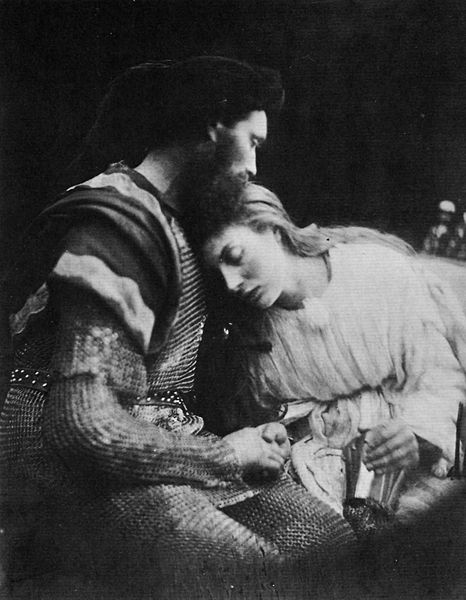
File:Cameron Lancelot und Guinevere 1874.jpg
The Parting of Sir Lancelot and Guinevere by Julia Margaret Cameron 

Story source: King Arthur: Tales of the Round Table by Andrew Lang and illustrated by H. J. Ford (1902).
Author's Note: Guinevere is the wife of Sir Arthur, King of Camelot. While they were married she had an affair with one of Arthur's closest knights, Sir Lancelot. After Arthur was slain in battle, it was written that Guinevere went to a nunnery and became renowned for how pious and devout she was. While she was there Lancelot came and saw her, but she sends him away. I wanted to elaborate on that encounter, because they have so much history and I think the emotion of their old affair combined with the pain of losing her husband is intriguing.

Week 12 Reading Notes Part B: King Arthur

-Seems like knights just walk around looking for grand ways to die. Where are their wives, reminding them not to act like toddlers and maybe just act reasonably for a day or two? I can feel the testosterone seeping out of these stories
-The castle of Maidens sounds like every guy's fantasy
-Lancelot is a lot more interesting of a character to me than Arthur. It seems that he tries to be good, but he has a past that is holding him back from the grand  and holy quests that are just outside his reach. That is much more human and much more realistic. Can you imagine being a knight and being on a quest for the holy grail and then it is within your grasp and you have to watch another knight take advantage of it, and then steal your sword and horse? That would be torture. That could be an excellent metaphor for our past holding us back from love, or a family, or the career we wanted, which is a sad but often too real truth.
-The nun is pretty harsh to Lancelot, basically saying that as far as being a sinner he is in a league of his own. Like he is the first guy to cheat on his wife. He obviously seems to repent his actions but the world just seems to keep punishing him even when he tries to make amends and do right.
-So after all the shame that they placed on Lancelot, he is kind of the last knight and he gets to have this grand burial and get to go up to heaven and be crowned the goodliest knight and truest lover- this all does not make a whole lot of sense to me. I found these stories to be very confusing

Story source: King Arthur: Tales of the Round Table by Andrew Lang and illustrated by H. J. Ford (1902).

File:Emil Teschendorff - Queen Guinevere bidding farewell to Sir Lancelot.jpg
Queen Guinevere bidding farewell to Sir Lancelot by Emil Teschendorff (1833-1894)

Week 12 Reading Notes Part A: King Arthur

-It is interesting that Merlin tried to counsel Arthur out of marrying Guinevere, saying that he could find someone who is just as pretty but is a much better person. It is like he knows that something bad is going to happen, but it is typical that Arthur only cares about her looks. I do agree with the statement that once a heart is set on someone it is futile to try and change it, however
-Women are getting a pretty bad rap in these tales. The woman who Merlin loved basically treated him like a plaything and then buried him alive after she had gained all his knowledge. His sister stole his scabbard and then tried to burn him alive with a mantle.
-Arthur is pretty one-dimensional. I wish he would have more of a struggle, I feel like the only struggle he has is being a little arrogant, which if you pull the sword out of the stone I think you're allowed to be a little arrogant.
-I have heard a lot about Guinevere in popular media and such but they almost begrudgingly give her a section of the story, and they allude to her possibly not being the best but then we just hear of her as "the queen" from then on
-It would be really interesting to hear about the feud between Arthur and his sister from Morgan's point of view- why did Arthur have to kill the knight that she loved? Was he a bad person? Or was Arthur being overprotective of his sister? Were they close before then? It would take a lot to cause a sibling to hate another so much that she tries to kill him, so the knight must have meant a lot to Morgan. There is a lot of potential there to flesh out

Story source: King Arthur: Tales of the Round Table by Andrew Lang and illustrated by H. J. Ford (1902).
File:Frank William Warwick Topham Voyage of King Arthur and Morgan Le Fay to the Isle of Avalon 1888.jpg
Voyage of King Arthur and Morgan Le Fay to the Isle of Avalon by Frank William Warwick Topham (1838-1924) - Source